
Skip to content Skip to main menu

Applications

RIS applications

RIS applications

Introducing key use cases and expected benefits of RIS (Reconfigurable Intelligent Surface).


RIS Application Overview


RIS actively controls the reflection and propagation characteristics of wireless signals to “reconfigure” the channel. This enables a wide range of application scenarios such as coverage extension, link stabilization, integrated sensing and communication (ISAC), and optimization for secure/special links.

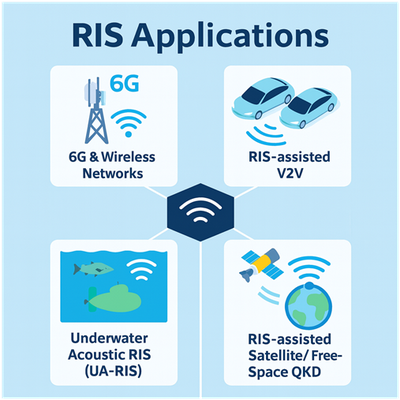
RIS Applications Infographic
RIS application infographic (6G / vehicles / V2V / underwater / satellite & free-space QKD)

Key Use Cases and Expected Benefits

Key Use Case Key Characteristics Expected Benefits


6G & Wireless Networks
Coverage extension and shadow-area mitigation
(high-frequency bands such as mmWave/THz)
Create virtual (LoS) communication paths for users in blocked areas and
improve link quality through sensor/camera-based channel awareness
Improved energy efficiency and capacity Provide the same communication quality with lower power and enhance network efficiency, and
increase throughput per user/area through intelligent reflective path configuration
Integrated Sensing and Communication (ISAC) Use wireless signals for communication while simultaneously sensing the surrounding environment like radar, and
improve user/device positioning awareness
RIS assisted V2V Create reliable links in environments where the direct path is blocked RIS installed on surrounding buildings/structures creates LoS/NLoS paths and
ensures highly reliable vehicle-to-vehicle links even in NLoS segments
Underwater Acoustic RIS (UA-RIS) Acoustic RIS Intelligently control acoustic signal propagation direction to improve underwater communication and sensing performance
RIS assisted Satellite / Free-Space QKD RIS phase quantization for optimizing quantum and RF channels Improve satellite-to-ground QKD link quality to reduce quantum bit error rate (QBER) and
increase the secure key rate (SKR)

Key Points by Application


6G & Wireless Networks

Coverage Extension · Energy Efficiency · ISAC

  • Flexibly shape propagation/reflection paths to extend coverage and mitigate shadow areas
  • Optimize links to achieve the same performance with lower power, improving energy efficiency
  • Use wireless signals for both communication and sensing to enhance environmental awareness (ISAC)
RIS assisted V2V

Reliable V2V links even in obstructed environments

  • Form reflective paths when direct links are blocked to increase link reliability
  • Stabilize quality in mixed LoS/NLoS environments for more consistent communication
  • Dynamically adjust RIS configuration to match channel changes due to vehicle mobility
Underwater Acoustic RIS (UA-RIS)

Enhanced underwater acoustic communication/sensing

  • Optimize acoustic paths considering attenuation, scattering, and multipath in underwater environments
  • Improve communication quality and sensing performance via intelligent reflection/path control
Satellite / Free-Space QKD

Optimizing satellite/free-space links and QKD

  • Assist reflection paths and beam alignment to improve free-space/satellite link quality
  • Contribute to lower QBER and higher SKR (Secure Key Rate) for QKD links