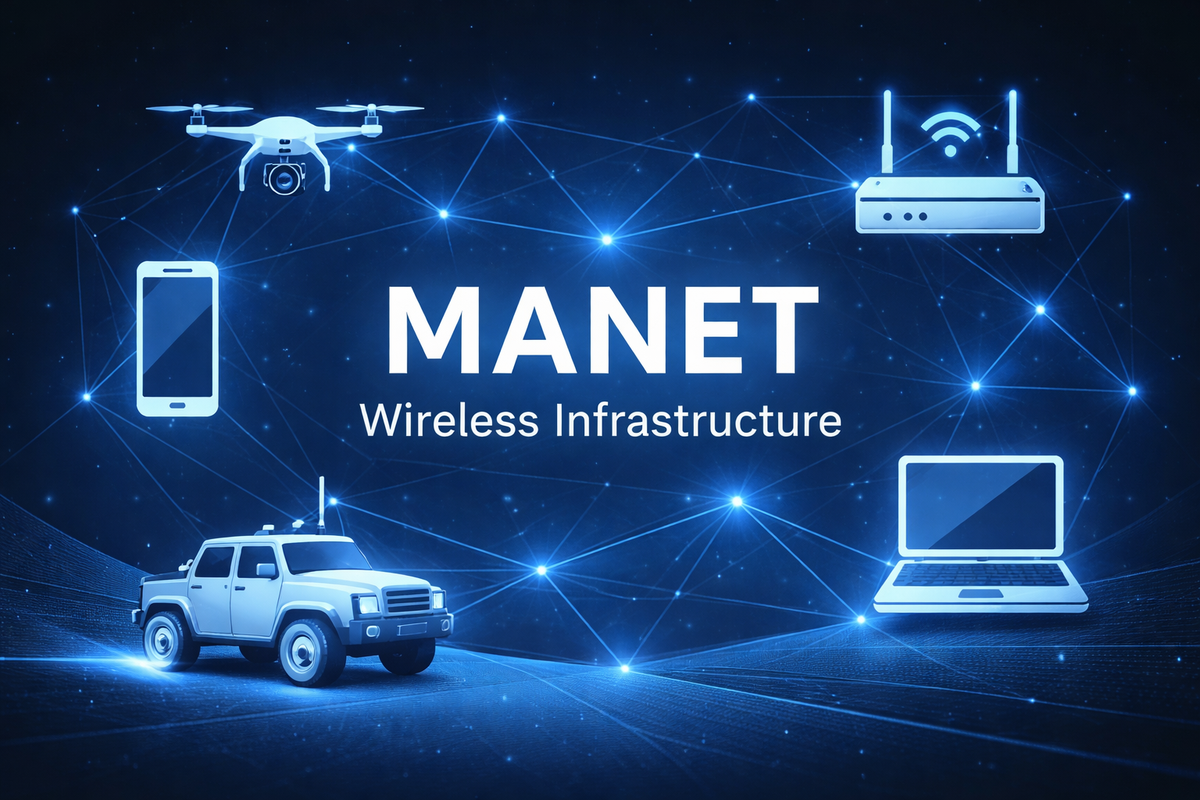
What is MANET (Mobile Ad-hoc Network)?
MANET has the following characteristics, and these features make it fundamentally
different from typical wired or cellular networks.
1. Autonomous, ad-hoc formation (Ad-hoc Nature)
- “Ad-hoc” implies “temporary” or “formed on demand.”
-
No base station or fixed infrastructure is required. Nodes discover one another and
establish links where they are, forming a network autonomously.
-
The network continuously reconfigures as nodes join or leave.
2. Dynamic topology (Dynamic Topology)
- All nodes can be mobile, so link states change frequently.
- The topology (connectivity structure) changes continuously and often unpredictably.
- Routing protocols must track these changes quickly and re-establish routes when
paths appear or disappear.
3. Multi-hop routing (Multi-hop Routing)
-
Nodes that are not within direct communication range can still exchange data
through intermediate nodes.
-
Even with limited per-node radio range, multi-hop routing extends overall coverage.
-
Since a single intermediate node failure can break an end-to-end path, route diversity
and fast re-routing are important.
4. Resource constraints (Resource Constraints)
-
Nodes often include battery-powered portable devices, smart devices, or sensors,
so power budgets are limited.
-
Wireless bandwidth and compute resources (CPU/memory) are also constrained compared
to wired networks, making energy efficiency and low overhead essential in protocol design.
5. Higher security exposure (Security Vulnerability)
-
Wireless links are more exposed to eavesdropping, spoofing, and replay attacks, and
centralized security appliances are difficult to deploy.
-
Many use cases operate in physically exposed environments (outdoors, disaster zones,
tactical settings), creating risks such as device capture and rogue nodes.
-
Distributed security mechanisms—encryption, authentication, key management, and
anomaly detection—must be designed for MANET operation.
Due to these characteristics, MANET requires different approaches to routing, resource
management, and security compared to wired or cellular networks.
MEWLink develops MANET infrastructure for real-world environments along with
protocol tuning and monitoring/analytics solutions.
What problems can MANET-based wireless
infrastructure solve?
1. Communication in environments with no infrastructure or damaged infrastructure
Problem : Network collapse and coverage holes due to disasters or conflict
In natural disasters such as earthquakes and typhoons—or in conflict situations—existing
infrastructure like base stations and repeaters can be destroyed or lose power.
In addition, mountainous terrain, underground spaces, and offshore areas are often hard
or inefficient to cover with conventional infrastructure.
Solution: Rapid, self-built communications network
MANET can form a network immediately using only available devices (nodes).
In emergencies, devices carried by responders (smartphones, radios, etc.)
can act
as routers to relay data and bypass broken links.
- Resilience: No single central point of failure—if some nodes fail, routes can automatically
detour through other nodes.
- Use cases: Disaster relief communications, tactical networks, and more.
2. Cost and time of building fixed infrastructure
Problem: High cost and long deployment time for fixed infrastructure
Deploying temporary coverage or installing base stations for large areas often requires
significant cost and long lead times.
Solution: Cost-efficient temporary network formation
MANET can be built using existing devices or relatively low-cost mobile nodes
(wireless sensors, drones, vehicles, etc.).
-
Efficiency: For large events, temporary construction sites, and short-term monitoring,
MANET enables cost-effective deployment and operation.
3. Communication in highly mobile environments
Problem: Maintaining seamless communication among fast-moving objects
Fast-moving platforms like vehicles and drones may leave cellular coverage areas or
experience interruptions during handover.
Solution: VANET and drone networks based on MANET
MANET can be applied to vehicle (VANET) or drone networking, where each platform acts
as a router to relay data to nearby nodes or control systems.
-
Stability: Enables low-latency communication for traffic sharing, collision warnings,
and real-time monitoring data—even while moving.
4. Connectivity challenges in IoT environments
Problem: Collecting data from massive sensors with power efficiency
In large farms or environmental monitoring zones, many IoT sensors must deliver data to
a central service. Direct long-range transmission for every sensor can be difficult and
power-hungry.
Solution: Efficient data aggregation through mesh networking
MANET can be implemented as a mesh sensor network where nearby nodes relay data
hop-by-hop to a gateway efficiently.
-
Power management: Relaying to nearby nodes reduces per-node transmit power and
can extend device lifetime.