
Head Office : Room 2611, Building A, Giheung ICT Valley, 58-1 Giheung-ro, Giheung-gu, Yongin-si, Gyeonggi-do, Korea
R&D Center : Room 2709, Building B, Giheung ICT Valley, 58 Giheung-ro, Giheung-gu, Yongin-si, Gyeonggi-do, Korea
MANET applications
Introducing key use cases and expected benefits of MANET.
MANET is a network where mobile nodes (smartphones, vehicles, sensors, etc.) act as both routers and hosts,
connecting directly or via multi-hop routes without fixed infrastructure.
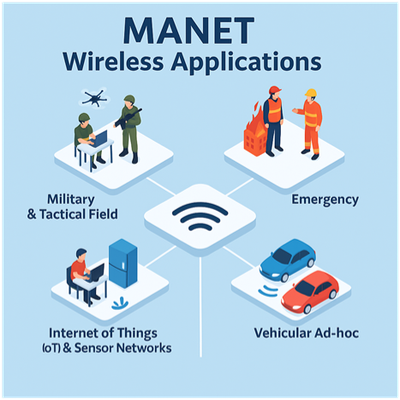
It is widely used in the field where rapid deployment and flexible topology are required, such as military/tactical operations, emergency and disaster response, IoT and sensor networks, and vehicular communications (VANET).
| Key Use Case | Key Characteristics | Expected Benefits |
|---|---|---|
| Military & Tactical Field | Build a communication network based on direct links among soldiers, vehicles, and command units in remote areas | Supports mobility and rapid deployment even where infrastructure is unavailable or cannot be restored |
| Emergency & Disaster Response | Establish a communication network for first responders when existing infrastructure is destroyed | Rapid deployment and data/voice sharing without dependence on fixed infrastructure |
| Internet of Things (IoT) & Sensor Networks | Configure distributed sensor networks for environmental monitoring, smart agriculture, smart factories, and more | Scales to wide domains through self-organizing capabilities and efficient protocols |
| Vehicular Ad-hoc Networks (VANETs) | Vehicle-to-vehicle (V2V) direct communications for collision warnings, traffic updates, and cooperative driving | Delivers safety-critical information and provides ad-hoc topology suitable for highly mobile environments |